For patients
Recording your consultation
Revised
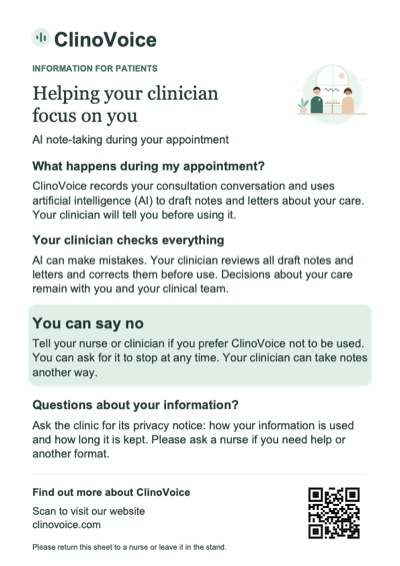
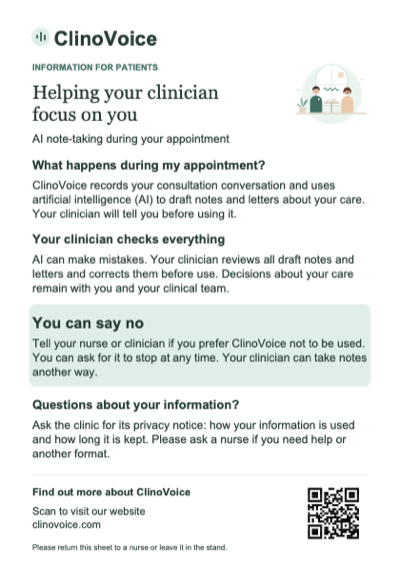
Your clinician may ask if they can record your consultation with ClinoVoice. This page explains what that means. You can say no, and your care will be exactly the same.
What is recorded?
The conversation in your appointment, in the room or on a phone or video call, from when your clinician starts the recording until they stop it. Your clinician will ask you first, every time.
What is the recording used for?
Only to help your clinician write the letter about your appointment, usually to your GP and sometimes to you. A computer service using artificial intelligence (AI) turns the recording into text and writes a first version of the letter. Your clinician reads it, corrects it and approves it. Nothing is sent until they have.
Can I say no?
Yes. Just say so. Your clinician will write the letter the usual way, and your care will not change. You can also ask them to stop at any time, even partway through, and the recording can be deleted.
Who handles the recording, and where?
The clinic or practice you are seeing is responsible for your information. ClinoVoice handles the recording for them, only on their instructions. Recordings and the letters written from them are stored in London and processed in the European Union, by the companies listed in our data processing agreement.
Is the recording kept?
Only for as long as your clinic has agreed with ClinoVoice, and then it is deleted. The letter becomes part of your medical record, as any clinic letter does. The data processing agreement has the details.
Who can I ask?
Ask the clinic or practice first. They are responsible for your information and can tell you more, including how to see it. For questions about ClinoVoice itself, our privacy notice explains how to contact us.
The leaflet
The same information as a leaflet, to print or to read on screen.